
Introduction:
Measures of dispersion MCQs are an essential part of competitive exam preparation for CSS, FPSC, PMS, and other tests. These questions assess how well a student understands the spread of data around a central value. While averages describe the center, dispersion explains how consistent or scattered the observations are.
In this collection, you will practice important concepts such as standard deviation, variance, and coefficient of variation. The focus is on building both conceptual clarity and problem-solving ability, which are crucial for success in exam-based statistics questions.

Figure: Key statistical measures of dispersion frequently tested in CSS, FPSC, PMS, and other competitive exams.
📑 Quick Navigation
- Important Definitions
- Formulas Cheat Sheet
- Concept Overview
- Key Types
- Examiner Traps
- MCQs 1–10
- MCQs 11–20
- MCQs 21–30
- MCQs 31–40
- MCQs 41–50
- MCQs 51–60 (Advanced)
- MCQs 61–70 (Advanced)
- 1-Minute Revision
- Comparison Table
- Key Differences
- Key Concepts
- Concept Reminder
- Flashcards
- Key Takeaways
- Conclusion
- FAQs
- Related Links
📘 Important Definitions (Measures of Dispersion)
📐 Formulas Cheat Sheet (Measures of Dispersion)
Overview of Measures of Dispersion
This MCQ collection systematically covers both basic and advanced aspects of measures of dispersion. It includes conceptual definitions, computational formulas, transformation properties, comparison techniques, and inferential applications. Students will encounter questions related to:
- Range and its limitations
- Variance and its algebraic properties
- Standard deviation and empirical rule (68%–95%–99.7%)
- Coefficient of variation for relative comparison
- Effect of linear transformations on dispersion
- Population vs sample variance (n vs n − 1)
- Interquartile range for skewed distributions
By practicing these Measures of Dispersion MCQs, aspirants can strengthen problem-solving speed, improve conceptual clarity, and prepare confidently for statistics-related questions in competitive exams. Each question is accompanied by a clear explanation to reinforce theoretical understanding and exam-oriented preparation.
📊 Key Types of Measures of Dispersion
⚠️ Examiner Trap Concepts
📌 Don’t just memorize—understand the demand of the question.
❌ Common Classroom Issue:
Students remember formulas but struggle in exams because they fail to interpret what is actually being asked.
🧠 Smart Thinking Approach:
Before solving, quickly identify:
• Is it about absolute dispersion? (Range, Variance, Standard Deviation)
• Or relative dispersion? (Coefficient of Variation)
💡 Golden Rule:
"First identify the type → then apply the formula 🎯"
PART-1 (MCQs 1–10)
Concept: Range measures total spread using extreme values only.
Trap: Students sometimes use average instead of extremes—this is incorrect.
Exam Use: In FPSC/CSS, range questions are often direct but may include hidden minimum/maximum values.
Key Idea: Variance is based on squared deviations from the mean.
Mistake: Confusing it with standard deviation, which is in original units.
Application: Squared units make variance useful in advanced statistical modeling and theory.
Standard deviation equals the square root of variance. If variance is zero, standard deviation is also zero in measures of dispersion.
The sum of squared deviations is least when measured from the arithmetic mean. This property defines variance in measures of dispersion.
Logic: Adding a constant shifts all values equally without changing spread.
Why Correct: Deviations from the mean remain unchanged after addition.
Exam Use: Frequently tested transformation rule—addition does NOT affect variance.
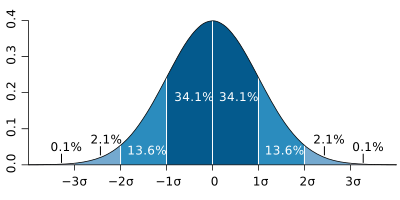
Figure: Standard deviation representing variability around the mean.
Concept: Standard deviation considers every observation, making it a complete measure of spread.
Trap: Students confuse it with range, which ignores most data points.
Exam Use: Questions often test which measure uses full dataset—standard deviation is the correct answer.
Key Idea: Range depends only on minimum and maximum values.
Mistake: Assuming it reflects overall distribution—this is incorrect.
Application: Examiners test this limitation to check conceptual understanding.
Logic: Standard deviation is the square root of variance.
Why Correct: √49 = 7 restores original units.
Exam Use: Very common direct numerical in FPSC and GAT exams.
Concept: Smaller standard deviation means values are closer to the mean.
Trap: Confusing it with higher variability—opposite is true.
Exam Use: Used to interpret consistency in datasets.
Concept: Variance depends on squared deviations, so scaling affects it quadratically.
Trap: Many students think it multiplies by 3 instead of 9.
Exam Use: Transformation-based MCQs are very common in CSS and PMS exams.
PART-2 (MCQs 11–20)
Concept: Variance increases as the number of observations (n) increases.
Trap: Thinking mean alone determines dispersion—incorrect.
Exam Use: Frequently appears in theoretical MCQs.
Key Idea: Variance is the square of standard deviation.
Mistake: Students sometimes multiply instead of squaring.
Application: Core formula tested in every competitive exam.
Concept: Coefficient of variation standardizes dispersion relative to mean.
Trap: Using standard deviation for cross-unit comparison—incorrect.
Exam Use: Essential for comparing datasets with different units.
Logic: Adding a constant shifts all values equally.
Why Correct: Spread around mean remains unchanged.
Exam Use: Classic transformation MCQ in exams.
Concept: Range depends on the gap between extreme values.
Trap: Confusing it with mean or median changes.
Exam Use: Often asked in conceptual questions.
Key Idea: Standard deviation cannot be negative as it is derived from squared values.
Mistake: Assuming negative values are possible.
Application: Fundamental property tested frequently.
Logic: Doubling frequencies scales numerator and denominator equally.
Why Correct: Relative spread remains unchanged.
Exam Use: Common conceptual trap in grouped data questions.
Concept: Standard deviation is defined as square root of variance.
Trap: Confusing it with mean deviation.
Exam Use: Basic but repeatedly tested concept.
Key Idea: Larger standard deviation indicates greater spread.
Mistake: Assuming it means consistency—incorrect.
Application: Used to compare variability between datasets.
Concept: Standard deviation scales directly with multiplication.
Trap: Thinking it squares like variance.
Exam Use: Important transformation rule.
⏱️ Under exam pressure, don’t calculate—identify!
🔍 Use this smart selection guide:
📊 Comparing two datasets?
→ Go for Coefficient of Variation (CV) (best for relative comparison)
📈 Spread around the mean?
→ Choose Standard Deviation (most commonly tested)
📦 Outliers or extreme values mentioned?
→ Switch to Interquartile Range (IQR) (robust measure)
💡 Exam Hack:
"Compare → CV | Spread → SD | Outliers → IQR"
PART-3 (MCQs 21–30)
Concept: Range links minimum and maximum values directly.
Trap: Students sometimes subtract incorrectly or reverse values.
Exam Use: Often tested with missing max/min values like this question.
Key Idea: Population variance uses total number of observations (N).
Mistake: Confusing it with sample variance formula (n − 1).
Application: Important distinction in inferential statistics MCQs.
Key Idea: Dividing by (n − 1) corrects bias in sample estimation.
Mistake: Using n instead of (n − 1) leads to underestimation of variance.
Application: Essential concept in inferential statistics and hypothesis testing.
Logic: Standard deviation measures spread around the mean.
Why Correct: Larger SD means values are more widely dispersed.
Exam Use: Frequently used in comparison-based MCQs.
Concept: Standard deviation is the square root of variance.
Trap: Students sometimes forget to take square root.
Exam Use: Direct calculation questions are very common.

Figure: Visualization of data dispersion around the mean using standard deviation in a normal distribution.
Key Idea: Standard deviation retains original units of measurement.
Mistake: Confusing it with variance, which uses squared units.
Application: Helps interpret dispersion in real-world terms.
Concept: Zero range means no difference between max and min.
Trap: Assuming distribution properties like symmetry.
Exam Use: Indicates no variability—important theoretical case.
Logic: Variance allows algebraic manipulation due to squared terms.
Why Correct: It integrates well with mathematical models.
Exam Use: Used heavily in advanced statistics and derivations.
Concept: Small SD relative to mean implies tight clustering.
Trap: Confusing it with skewness or distribution shape.
Exam Use: Used to assess consistency in datasets.
Key Idea: Coefficient of variation expresses relative dispersion.
Mistake: Forgetting to multiply by 100.
Application: Essential for comparing datasets across different scales.
PART-4 (MCQs 31–40)
Concept: Adding a constant shifts data without changing spread.
Trap: Thinking variance increases with addition.
Exam Use: Highly repeated transformation rule.
Logic: Variance depends on squared deviations.
Why Correct: Multiplying by 3 increases variance by 9.
Exam Use: Common conceptual MCQ in exams.
Key Idea: Standard deviation measures average spread in original units.
Mistake: Confusing it with variance or mean deviation.
Application: Most widely used dispersion measure.
Concept: Range reacts strongly to extreme values.
Trap: Assuming all measures respond equally to outliers.
Exam Use: Used to test understanding of sensitivity.
Logic: IQR focuses on middle 50% of data.
Why Correct: Q3 − Q1 captures central spread.
Exam Use: Important for skewed distributions.
Concept: Zero SD means no variability at all.
Trap: Assuming other distribution properties apply.
Exam Use: Indicates identical observations.
Key Idea: IQR resists influence of extreme values.
Mistake: Using standard deviation for skewed data.
Application: Preferred measure for non-normal distributions.
Concept: CV standardizes variability across datasets.
Trap: Using it when mean is zero.
Exam Use: Useful for comparing performance or consistency.
Logic: Variance measures average squared spread.
Why Correct: Larger value means wider dispersion.
Exam Use: Core interpretation-based MCQ.
Key Idea: Standard deviation is widely used in inferential statistics.
Mistake: Assuming range is sufficient for analysis.
Application: Used in confidence intervals and hypothesis testing.
PART-5 (MCQs 41–50)
Concept: Variance of first n natural numbers follows a standard formula.
Trap: Confusing it with sum formula n(n+1)/2.
Exam Use: Frequently appears in advanced numerical MCQs.
Logic: Variance is square of standard deviation.
Why Correct: 4² = 16 gives dispersion in squared units.
Exam Use: Direct formula-based MCQ.
Key Idea: Lower coefficient of variation means higher consistency.
Mistake: Comparing absolute values instead of relative dispersion.
Application: Used in comparing performance of datasets.
Concept: Standard deviation is expressed in original units.
Trap: Confusing it with variance (squared units).
Exam Use: Helps in real-world interpretation of data spread.
Logic: Standard deviation is the square root of variance.
Why Correct: √25 = 5 restores unit consistency.
Exam Use: Basic but high-frequency numerical question.
Concept: Empirical rule defines spread in normal distribution.
Trap: Mixing 68%, 95%, and 99.7% ranges.
Exam Use: Very common in theoretical MCQs.
Key Idea: Squaring CV relates to relative variance.
Mistake: Confusing it with absolute variance.
Application: Useful in comparative statistical analysis.
Concept: Higher standard deviation means greater spread.
Trap: Assuming equal mean implies equal dispersion.
Exam Use: Common comparison-based question.
Logic: Variance is based on squared values.
Why Correct: Squares cannot produce negative results.
Exam Use: Tests fundamental properties of dispersion.
Concept: Dispersion measures variability around central value.
Trap: Confusing it with central tendency.
Exam Use: Basic conceptual MCQ.
PART-6 (MCQs 51–60)
Concept: In transformation X' = aX + b, variance becomes a²σ².
Trap: Students often ignore the square on the coefficient.
Exam Use: Very high-yield transformation rule in CSS/FPSC exams.
Logic: Variance directly reflects spread of observations.
Why Correct: 25 > 16 means Dataset B is more dispersed.
Exam Use: Common comparison-based MCQ in exams.
Concept: CV = (SD / Mean) × 100; if SD = 0, CV = 0.
Trap: Confusing zero CV with zero mean.
Exam Use: Indicates perfect consistency in dataset.
Key Idea: Empirical rule: 95% data lies within ±2 SD.
Mistake: Mixing it with 68% or 99.7% ranges.
Application: Frequently tested in theoretical MCQs.
Logic: Adding a constant shifts data but does not affect spread.
Why Correct: Deviations from mean remain unchanged.
Exam Use: Classic transformation concept in exams.
Concept: CV depends directly on standard deviation when mean is constant.
Trap: Ignoring proportional relationship.
Exam Use: Important in relative variability questions.
Logic: Range uses only maximum and minimum values.
Why Correct: Extreme values strongly influence it.
Exam Use: Tests sensitivity of dispersion measures.
Concept: Lower variance means observations are tightly clustered.
Trap: Relating it incorrectly with mean value.
Exam Use: Used in interpretation-based MCQs.
Key Idea: Grouped data calculations rely on class midpoints.
Mistake: Ignoring frequencies in calculations.
Application: Essential for practical statistics problems.
Logic: CV = (SD / Mean) × 100 formula applies.
Why Correct: (5/50)×100 = 10%.
Exam Use: Frequently asked numerical MCQ.
PART-7 (MCQs 61–70)
Reason (R): It is the square root of variance.
Concept: Standard deviation is square root of variance.
Trap: Expecting negative values.
Exam Use: Assertion-reason MCQs frequently test this.
Key Idea: Standard deviation measures absolute dispersion.
Mistake: Linking it with mean difference.
Application: Equal SD means equal spread.
Concept: CV standardizes dispersion relative to mean.
Trap: Using SD when units differ.
Exam Use: Essential for cross-dataset comparison.
Logic: SD changes by |a| under multiplication.
Why Correct: −4 affects direction, not magnitude.
Exam Use: Important transformation MCQ.
Concept: IQR focuses on central 50% of data.
Trap: Using SD for skewed datasets.
Exam Use: Preferred measure for outlier-resistant analysis.

Figure: Interquartile range as a robust measure of dispersion.
Logic: Zero variance means all values are identical.
Why Correct: No difference → range becomes zero.
Exam Use: Fundamental property MCQ.
Concept: Mean minimizes sum of squared deviations.
Trap: Confusing with median or mode.
Exam Use: Core theoretical concept in statistics.
Key Idea: Lower CV indicates higher consistency.
Mistake: Choosing higher CV incorrectly.
Application: Used in performance comparison.
Logic: SD = (CV × Mean) / 100.
Why Correct: (20 × 100)/100 = 20.
Exam Use: Common reverse-calculation MCQ.
Concept: Dividing by (n − 1) removes bias in estimation.
Trap: Using n instead of (n − 1).
Exam Use: Critical concept in inferential statistics.
🎯 How to Solve Dispersion MCQs in Exams
💡 Smart Strategy: In exams, speed comes from clarity. Train your mind to recognize the type of question before jumping into calculations.
- 🔍 Identify first: Is it conceptual or numerical? This saves time instantly
- 🔄 Check transformations: Addition does not change dispersion, multiplication does
- 🧠 Spot keywords: Words like "increase", "multiply", or "compare" reveal the method
- ❌ Use elimination: Remove wrong options quickly in tricky MCQs
⚡ Exam Hack: "Identify → Analyze → Eliminate → Answer 🎯"
⚠️ Common Mistakes Students Make
🚫 Avoid these frequent errors to boost your score:
- ⚠️ Confusing variance with standard deviation
- 📉 Forgetting to take square root when required
- 📊 Applying coefficient of variation when mean is zero (invalid case)
- 🔁 Ignoring transformation rules in conceptual MCQs
💡 Quick Fix: Revise concepts, not just formulas—this prevents repeated mistakes.
📊 FPSC / CSS Paper Trend
📈 In recent papers, statistics MCQs are shifting from direct calculation to conceptual interpretation. Examiners now focus more on how well you understand dispersion in statistics rather than how fast you apply formulas.
🎯 Questions commonly test data variability, transformation rules, and real-life application. For effective CSS statistics preparation, prioritize understanding patterns, relationships, and logic behind the formulas instead of rote learning.
🚀 Final Advice: "Concept clarity = High score in competitive exams"
⚡ 1-Minute Revision Table (Must Review Before Exam)
| Concept | Formula / Idea | Key Insight |
|---|---|---|
| Range | Max − Min | Uses only extreme values |
| Variance | σ² | Measured in squared units |
| Standard Deviation | √Variance | Most widely used measure |
| Coefficient of Variation | (SD / Mean) × 100 | Unit-free comparison |
📊 Comparison of Measures of Dispersion
| Measure | Uses All Data? | Unit | Sensitivity to Outliers |
|---|---|---|---|
| Range | No | Same | Very High |
| Variance | Yes | Squared | High |
| Standard Deviation | Yes | Same | Moderate |
| IQR | Partial (middle 50%) | Same | Low |
🔑 Key Differences
🧠 Key Concepts Students Should Remember
Dispersion measures how data spreads around the mean. While range gives a quick estimate, standard deviation provides deeper insight by considering all observations.
- Range is simple but ignores most data points
- Standard deviation is the most reliable and widely used measure
- Variance is in squared units, making it less interpretable
- Coefficient of variation is best for comparing datasets
- IQR is ideal for skewed data and outliers
- Transformation rules are frequently tested in exams
🔁 Concept Reminder
Always identify whether the question is asking for absolute or relative dispersion. This determines the correct measure to use.
Remember the key transformation rule: adding a constant does not affect dispersion, while multiplication changes it significantly.
⚡ 10-Second Revision Flashcards (Measures of Dispersion)
🎯 Key Takeaways
Mastering measures of dispersion is essential for solving advanced exam questions. Concepts like data spread, variability, and comparison help students approach problems logically rather than relying on memorization.
Whether you are solving standard deviation or variance-based questions, the key lies in understanding their application. Strong conceptual clarity enables students to handle both theoretical and numerical problems effectively in competitive exams.
📌 Concluding Analytical Perspective
Understanding dispersion is essential for interpreting real-world data, as it reveals how values are distributed around the mean rather than relying solely on averages.
Two datasets may have the same mean but behave entirely differently depending on their spread and variability, making dispersion a critical tool for deeper analysis.
In competitive examinations, success depends on conceptual clarity and correct application rather than memorization. Knowing when to use range, standard deviation, IQR, or coefficient of variation provides a clear advantage.
❓ Frequently Asked Questions
These frequently asked questions clarify key concepts of measures of dispersion and help reinforce exam preparation.
🔗 Related Topics for Better Understanding
To strengthen your concepts in statistics MCQs, you should also explore related topics that are frequently asked in CSS, FPSC, PMS, and GAT exams:
- 📊 Measures of Central Tendency MCQs (Mean, Median, Mode)
- 📈 Skewness and Kurtosis MCQs
- 📉 Frequency Distribution MCQs
💡 Tip: These topics are interconnected and often appear together in exams.
For theoretical understanding, you may also refer to the official explanation of Standard Deviation – Wikipedia , which explains the mathematical foundation and applications in inferential statistics.
Disclaimer: These MCQs are created for educational and practice purposes only. They are designed to support competitive exam preparation including CSS, FPSC, PMS, GAT, and university-level assessments.
Author Credentials: The author has extensive teaching experience in statistics and has guided students for CSS, FPSC, PMS, and university exams for several years.
Last Updated: 29 March 2026
Post a Comment
Please post only relevant educational questions or corrections related to this MCQs topic. Spam, promotional, or inappropriate comments will be removed.